
Vol 5 No 4 | Jan-Mar 2026
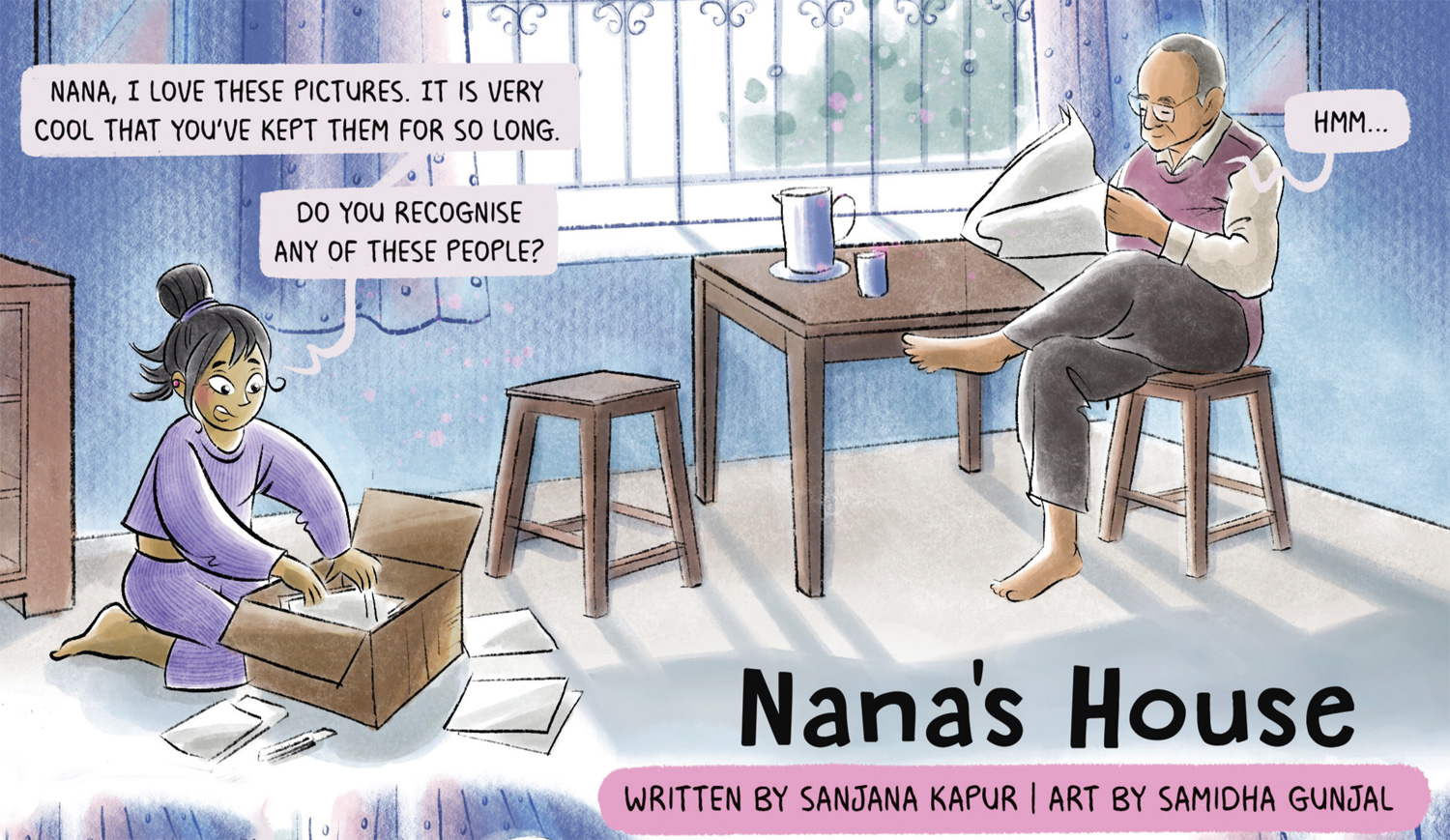
Nana’s House
Story by Sanjana Kapur | Art by Samidha Gunjal
My history
Around the time I turned 17, I started realising all the interesting lives my grandparents and parents had lived, and I decided to question them more. I felt a need to know where I had come from and where my story truly began.
All four of my grandparents had come over from what is now Pakistan during the Partition. Some of them had an easier journey than the others. My Nani was the daughter of a well-known lawyer and she flew to Chandigarh days before the Partition was made official. The rest of my grandparents travelled to India on foot and via a mix of whatever transportation was available to them. They somehow found each other in India and the rest is my history. What does the knowledge of my personal history tell me about how I am tied to the larger narrative and history as a whole?
The larger picture
The story of the Partition isn’t unknown. There are countless sources and stories describing the events that unfolded. We know how British India was divided and we know the countless lives that were lost in the mass migration that followed political decisions taken within important rooms.
Two days after India and Pakistan gained their independence, a demarcation line, named after a British lawyer, was published. The Radcliffe Line marked out the partition of Punjab and the partition of Bengal to create the newly independent Republic of India and the Islamic Republic of Pakistan. That line defined whether you belonged where you were or would have to leave behind your deep roots. It is easy to forget but the differences between people on both sides of that line are far fewer than the things they have in common.
A sort of true story
As much as I would have liked to ask my grandparents more questions, I didn’t. What I have instead is boxes of photographs filled with faces I don’t recognise. I also have stories that live on in their children. So I’m trying to make amends and get to know them better.
During one of the deep dives into reading other people’s stories I found myself on The Brown History Instagram page. When I realised that they invited personal stories, I wrote to them on a whim with a picture of my Nana and Nani. I wrote about how all four of my grandparents had travelled during the Partition; I wrote about my Nana and his life in Sialkot.
The page posted my story and it got an immense response. People wrote in from Pakistan and India, sharing similar journeys that their grandparents had made. Among those messages was a message from someone in Sialkot who offered to look for my Nana’s house. Unfortunately, I had very limited information about the house and Nana wasn’t around to ask. So I thanked them and that was it. The thing about telling stories is that you can rewrite some bits and fulfill a ‘what if’. What if my Nana were around? What if we knew where he had grown up? And what if I had asked him for his story when he was around?
The post on Brown History: https://www.instagram.com/p/CQhc_AznE-3/?img_index=1
Resources for further information:
https://brownhistory.substack.com/p/ep-35-partition-with-aanchal-malhotra?utm_source=publication-search
A museum in Amritsar dedicated to the Partition:
https://www.partitionmuseum.org/
An archive of personal histories from the Partition:
https://www.1947partitionarchive.org/
The Empire Podcast
(Episodes 278 to 283 talk about different aspects of the Partition):
https://open.spotify.com/episode/0cmPcHKlm6qp8IHBozX1sI
Other social media projects with information and personal histories:
https://www.instagram.com/indianmemoryproject/
https://www.instagram.com/citizensarchiveofindia/?hl=en
