
Vol 6 No 3 | Oct-Dec 2026
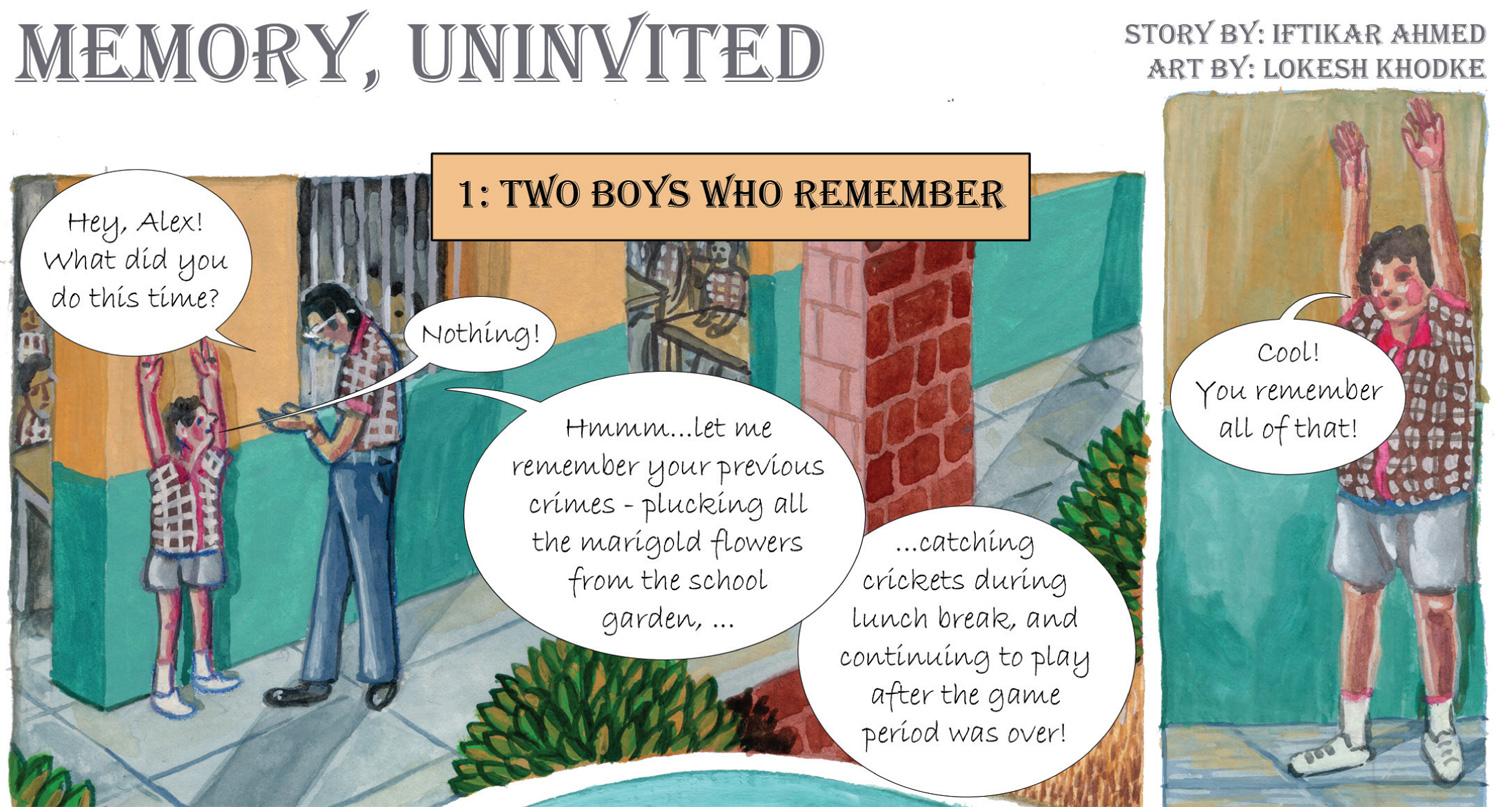
Memory, Uninvited
Story by Iftikar Ahmed | Art by Lokesh Khodke
Memory is strange because it does not preserve the past according to importance.
It keeps fragments. A smell, an embarrassment, a sentence overheard years ago, the colour of a wall, an object whose importance is difficult to explain. It can hold on to something tiny for decades and lose something that once seemed impossible to forget.
This unpredictability makes memory feel almost human.
That became one of the central ideas behind this story: what if Memory were not simply an ability of the mind, but a person? What kind of presence would it have? Would people enjoy its company? Would it know when to remain silent? Would it understand that certain things are expected to fade?
Probably not.
Memory does not have particularly good manners.
It brings back what has been pushed aside. It preserves details without asking whether they deserve preservation. Sometimes it gives us comfort. Sometimes it embarrasses us. Sometimes it protects people and places from disappearing entirely. At other times, it prevents the past from becoming neat.
Jorge Luis Borges’s Funes the Memorious is one useful literary echo of this idea: Borges, Memory and Funes the Memorious.
We often speak of having a “good memory” as though remembering more were automatically useful. Students are rewarded for remembering facts. Remembering names is considered thoughtful. Remembering an old conversation can be an act of affection.
But memory becomes more complicated when it refuses to remember selectively.
Human beings are constantly editing their own pasts. Some experiences are repeated until they become family stories. Others are quietly dropped. Some objects are carefully preserved while others are thrown away. A photograph may survive while the argument that happened immediately before it vanishes. An old ticket may remain in a drawer long after the journey itself has blurred.
Memory is also not a perfect recording of experience. Remembering can involve reconstruction, distortion and reinterpretation. Daniel Schacter’s short film, Are all of your memories real?, offers one way into that question.
This is also where memory occasionally brushes against History.
History tries to organise the past into something that can be recorded and understood. Memory is much less disciplined. It retains details that may never enter an archive, textbook or official account. Sometimes the smallest recollection can preserve something that a larger history has overlooked.
Paul Ricoeur’s Memory, History, Forgetting sits close to this tension: Memory, History, Forgetting.
But memory itself is not an archive.
An archive is built intentionally. Memory accumulates.
It works through attachment, repetition, accident, emotion and association. Often we do not even know why a particular detail has survived. Something remains simply because, for reasons hidden even from us, the mind refused to throw it away.
Perhaps that is why objects so often become containers for memory. A ticket, a notebook, a broken badge, an old photograph or an apparently useless scrap can suddenly hold an entire period of life. Their material value may be negligible. Their mnemonic value can be enormous.
Memory therefore has its own peculiar logic.
It does not always preserve what was most important but what remained.
And sometimes, years later, those surviving fragments tell us something about the past that the larger stories have forgotten.
– Iftikar Ahmed
