
Vol 5 No 4 | Jan-Mar 2026
A Whiff of Rice and Gunpowder.
Story and art by Amalendu Kaushik
A Personal Memory, Not Just History
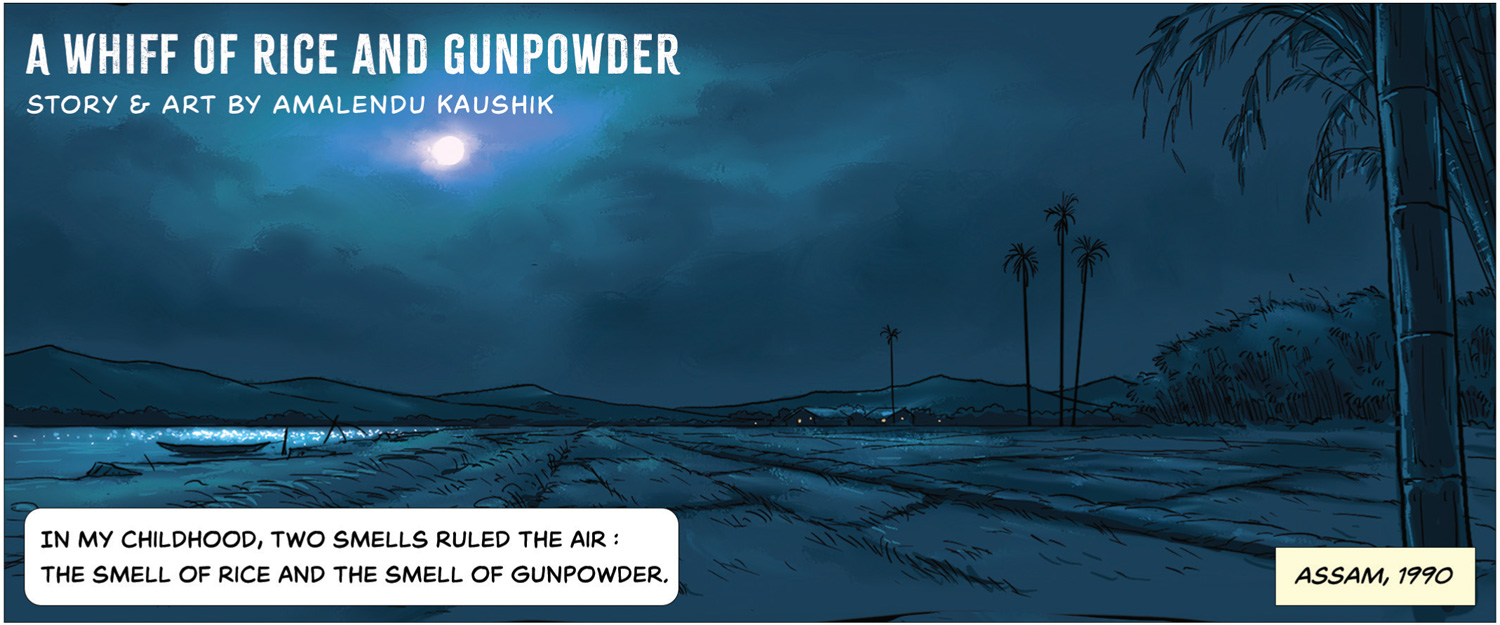
This is a personal story. It is rooted in memories passed down from my mother’s childhood in Assam during the 1980s and early ’90s, a time when everyday life unfolded under the shadow of insurgency and military operations.
Growing up later in North Lakhimpur in Upper Assam, I witnessed the lingering presence of what people called the “black cats”, armed patrols, whispers, fear, and silence. Even when the intensity of conflict had faded, the presence of the militant group United Liberation Front of Assam (ULFA) still felt real in the social imagination of Assam.
For many families, these were not distant political events but lived experiences that shaped childhood, conversations, and ways of seeing the world. Later, when my parents moved from Lakhimpur to Guwahati, I grew up in a city. Yet, even in an urban space, the echoes of insurgency were impossible to escape.
Assam bandhs, news about ULFA, and stories of encounters were omnipresent. The conflict also affected tourism for the longest time, shaping how the region was perceived from outside. Today, things are changing and people are slowly opening up, but I still hear stories of young people being recruited into ULFA even now. The past has not fully disappeared.
This comic emerges from those inter-generational memories, where personal stories and political history blur into one another.
Assam, insurgency, and the search for identity
The story is tied to the larger histories of Assam and North-east India, including the Armed Forces Special Powers Act (AFSPA), militarisation in Upper Assam, and training camps across the border in Kachin, Myanmar. These landscapes are not just geographical spaces but emotional and ideological territories where questions of belonging, autonomy, and identity have long been negotiated.
Much of this history resonates with the writings of Parag Kumar Das, one of Assam’s most powerful voices on identity and resistance, who was assassinated in broad daylight in 1996. His work continues to shape the political and cultural imagination of the region and reminds us that the struggle for identity in Assam has often been paid for with lives.
https://nelitreview.blogspot.com/2011/12/no-separatist-treatise-revisiting-parag.html
https://en.wikipedia.org/wiki/Assam_separatist_movements
Two sides of insurgency
Insurgency is rarely a simple story of heroes and villains. It contains contradictions, moral ambiguities, and human vulnerabilities. Journalist Sanjoy Hazarika’s book ‘Strangers of the Mist’ explores this complexity by showing how war and peace coexist in North-east India, and how violence and compassion often share the same space.
In the comic, this duality appears through the grandmother’s act of feeding a hungry ULFA cadre. The rebels are not portrayed as myths or ghosts but as young, fragile human beings carrying dreams, hunger, and fear. At the same time, the army is shown as both an instrument of state power and a source of everyday terror.
The story does not simplify either side.
https://books.google.co.in/books?id=PuWN7c81X5gC&printsec=copyright&redir_esc=y#v=onepage&q&f=false
Remembering Assam through empathy
At its core, ‘A Smell of Rice and Gunpowder’ is an attempt to tell the story of Assam through memory, smell, and emotion rather than slogans or headlines. For a generation that grew up after the peak of insurgency, much of this history has been skipped or forgotten, yet its traces remain in silence, fear, identity, and everyday life. Through this comic, I wanted to bring forward stories of Assam, historically and culturally, not to glorify violence but to view them with empathy. To understand that behind every conflict lie ordinary lives, ordinary kitchens, and ordinary people trying to survive extraordinary times.
